
Disintermediation, Reintermediation, Repeat
Two claims opened this series. First: programmatic is a transaction mechanism, not a magic pill for increased revenue. Second: whether it actually helps or quietly costs you depends on the kind of market you’re operating in, and the operators protecting their margins are the ones who control their own order of sale instead of handing that decision to whichever exchange is asking.
Here’s what makes both of those more than opinion: none of it is new. It’s happened before — more than once — and there’s a name for the pattern underneath it, taught well outside DOOH, mostly in travel and retail: disintermediation, then reintermediation. An industry cuts out the middleman, gets comfortable, then someone builds a new middleman on top of the old one, and the whole cycle starts again. Hotels lived through it with online travel agents. Retail lived through it with marketplaces. DOOH has now lived through it four separate times, and almost nobody selling the current layer ever frames it that way.
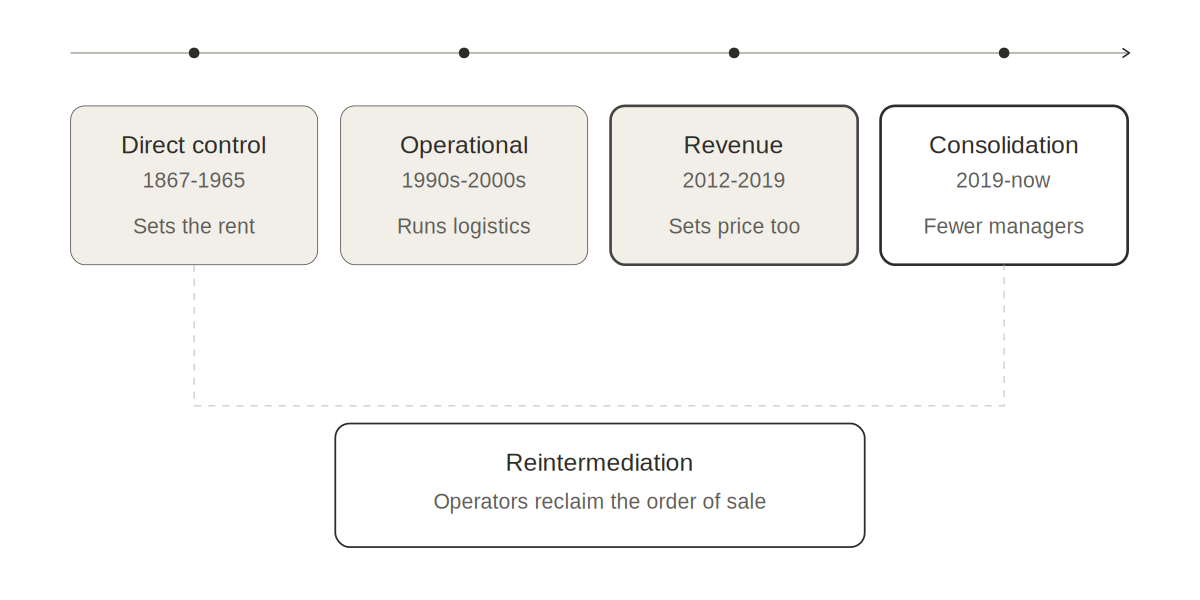
Four turns. Same question every time: who’s actually holding the keys?
Turn one, 1867–1965: you’re the landlord, full stop. Direct leasing, no middleman. You know the tenant, you set the rent.
Turn two, 1990s–2000s: the boards went digital. You hire a property manager — for maintenance only. The first CMS platforms show up to handle the new screens’ logistics. You still decide who rents and at what price. Disintermediation, but only operational.
Turn three, 2012–2019: the manager gets the keys. Programmatic exchanges launch, promising automated efficiency. The property manager stops just handling logistics and starts deciding who moves in and what they pay. Most operators handed that over because the pitch sounded like an upgrade.
Turn four, 2019–now: the managers merge. In under three years, the independent middle layer swallows itself — major platforms absorbed into a shrinking number of full-stack owners. Fewer managers, less real choice about who’s holding your keys. And the first signs of reintermediation start here too, as some operators begin reclaiming the order of sale instead of accepting it by default.
Here’s the part that matters more than any single date: the fourth turn of this cycle is also where reintermediation usually starts. In travel, it was hotels rebuilding direct booking to cut OTAs back out. In DOOH, it’s operators starting to reclaim the order of sale — deciding what leaves their inventory, when, and on whose terms, instead of accepting whatever the platform layer decides by default. Same cycle other industries have already run. DOOH is just running it a few decades later, on screens instead of hotel rooms.
None of these required villains. CMS vendors solved a real problem. Programmatic exchanges solved a real problem too. Every turn of this cycle looked like progress at the time it happened — that’s exactly what makes it easy to miss.
Four turns. Same underlying question, every time: who’s actually holding the keys to the building matters.
Next: what happens once the landlord stops checking on the property — and the one question that decides whether you’re still setting the terms, or just getting whatever payout someone else decided on.


